题目序号 223、
223. Rectangle Area
Find the total area covered by two rectilinear rectangles in a 2D plane.
Each rectangle is defined by its bottom left corner and top right corner as shown in the figure.
Rectangle Area
Example:
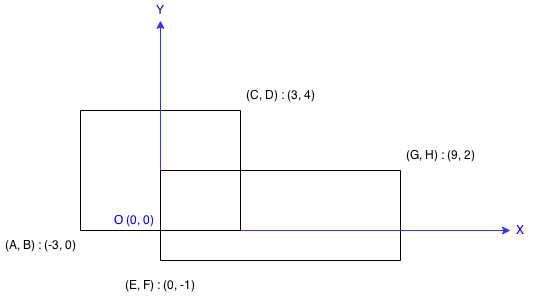
Input: A = -3, B = 0, C = 3, D = 4, E = 0, F = -1, G = 9, H = 2 Output: 45 Note:
Assume that the total area is never beyond the maximum possible value of int.
class Solution(object):
    def computeArea(self, A, B, C, D, E, F, G, H):
        """
        :type A: int
        :type B: int
        :type C: int
        :type D: int
        :type E: int
        :type F: int
        :type G: int
        :type H: int
        :rtype: int
        """
        return (C - A) * (D - B) + (H - F) * (G - E) - max(min(C, G) - max(A, E), 0) * max(min(D, H) - max(B, F), 0)
class Solution:
# @param {integer} A
# @param {integer} B
# @param {integer} C
# @param {integer} D
# @param {integer} E
# @param {integer} F
# @param {integer} G
# @param {integer} H
# @return {integer}
def computeArea(self, A, B, C, D, E, F, G, H):
    S=(C-A)*(D-B) + (G-E)*(H-F)
    if A>G or C<E or D<F or B>H :
        return S
    else:
        s_common=(min(C,G)-max(A,E))*(min(D,H)-max(B,F))
        return S-s_common


def computeArea(self, A, B, C, D, E, F, G, H):
    overlap = max(0, min(C, G)-max(A, E)) * max(0, min(D, H)-max(B, F))
    return (C-A)*(D-B)+(G-E)*(H-F)-overlap
83. Remove Duplicates from Sorted List
Given a sorted linked list, delete all duplicates such that each element appear only once.
Example 1:
Input: 1->1->2 Output: 1->2 Example 2:
Input: 1->1->2->3->3 Output: 1->2->3
def deleteDuplicates(self, head):
    node = head
    while node and node.next:
        if node.val == node.next.val:
            node.next = node.next.next
        else:
            node = node.next
    return head


def deleteDuplicates1(self, head):
    node = head
    while node and node.next:
        if node.val == node.next.val:
            node.next = node.next.next
        else:
            node = node.next
    return head

def deleteDuplicates(self, head):
    dic = {}
    node = head
    while node:
        dic[node.val] = dic.get(node.val, 0) + 1
        node = node.next
    node = head
    while node:
        tmp = node
        for _ in xrange(dic[node.val]):
            tmp = tmp.next
        node.next = tmp
        node = node.next
    return head

def deleteDuplicates(self, head):
    dic = {}
    node = head
    while node:
        dic[node.val] = dic.get(node.val, 0) + 1
        node = node.next
    node = head
    dummy = pre = ListNode(0)
    dummy.next = head
    while node:
        if dic[node.val] > 1:
            tmp = node
            for _ in xrange(dic[node.val]):
                tmp = tmp.next
            pre.next = tmp
            node = tmp
        else:
            pre = node
            node = node.next
    return dummy.next
class Solution(object):
    def deleteDuplicates(self, head):
        """
        :type head: ListNode
        :rtype: ListNode
        """
        if not head:
            return head
        dummy = prev = ListNode(None)
        while head:
            if head.val == prev.val:
                if not head.next:
                    prev.next = None
            else:
                prev.next = head
                prev = prev.next
            head = head.next

        return dummy.next

class Solution(object):
    def deleteDuplicates(self, head):
        """
        :type head: ListNode
        :rtype: ListNode
        """
        dummy = head
        while head:
            while head.next and head.next.val == head.val:
                head.next = head.next.next    # skip duplicated node
            head = head.next     # not duplicate of current node, move to next node
        return dummy
82. Remove Duplicates from Sorted List II
Given a sorted linked list, delete all nodes that have duplicate numbers, leaving only distinct numbers from the original list.
Example 1:
Input: 1->2->3->3->4->4->5 Output: 1->2->5 Example 2:
Input: 1->1->1->2->3 Output: 2->3
class Solution(object):
    def deleteDuplicates(self, head):
        """
        :type head: ListNode
        :rtype: ListNode
        """
        dummy = prev = cur = ListNode(None)
        while head:
            while head and ((head.val == prev.val) or (head.next and head.next.val == head.val)):
                prev = head
                head = head.next
            cur.next = head
            cur = cur.next
            if head:
                head = head.next

        return dummy.next
class Solution(object):
    def deleteDuplicates(self, head):
        """
        :type head: ListNode
        :rtype: ListNode
        """
        if not head:
            return None
        nxt, is_head_dup = head.next, False
        while nxt and nxt.val == head.val:
            nxt, is_head_dup = nxt.next, True
        head.next = self.deleteDuplicates(nxt)
        return head.next if is_head_dup else head


def deleteDuplicates(self, head):
    dummy = pre = ListNode(0)
    dummy.next = head
    while head and head.next:
        if head.val == head.next.val:
            while head and head.next and head.val == head.next.val:
                head = head.next
            head = head.next
            pre.next = head
        else:
            pre = pre.next
            head = head.next
    return dummy.next
141. Linked List Cycle
Given a linked list, determine if it has a cycle in it.
Follow up: Can you solve it without using extra space?
# Definition for singly-linked list.
# class ListNode:
#     def __init__(self, x):
#         self.val = x
#         self.next = None

class Solution:
    # @param head, a ListNode
    # @return a boolean
    def hasCycle(self, head):
        if not head:
            return False

        slow = fast = head
        while fast and fast.next:
            slow = slow.next
            fast = fast.next.next
            if slow is fast:
                return True

        return False
用个字典记录某个点是否被访问过,时间,空间复杂度都是O(n) .. code-block:: python
- class Solution(object):
- def hasCycle(self, head):
“”” :type head: ListNode :rtype: bool “”” if not head:
return Falselookup = {} while head:
- if head in lookup:
- return True
lookup[head] = 1 head = head.next
return False
时间复杂度: O(N) 空间复杂度: O(1)
class Solution(object):
    def hasCycle(self, head):
        """
        :type head: ListNode
        :rtype: bool
        """
        slow = head
        fast = head
        while fast and fast.next:
            slow = slow.next
            fast = fast.next.next
            if slow == fast:
                return True
        return False
142. Linked List Cycle II
Given a linked list, return the node where the cycle begins. If there is no cycle, return null.
Note: Do not modify the linked list.
Follow up: Can you solve it without using extra space?
def detectCycle(self, head):
    fast = slow = head
    while fast and fast.next:
        fast = fast.next.next
        slow = slow.next
        # if there is a cycle
        if slow is fast:
            # the head and slow nodes move step by step
            while head:
                if head == slow:
                    return head
                head = head.next
                slow = slow.next
    return None


def detectCycle1(self, head):
    dic = {}
    while head:
        if head in dic:
            return head
        dic[head] = 0
        head = head.next
    return None

def detectCycle(self, head):
    if not head:
        return None
    fast = slow = head
    while fast and fast.next:
        fast = fast.next.next
        slow = slow.next
        if fast is slow:
            fast = head
            while fast and fast != slow:
                fast = fast.next
                slow = slow.next
            return fast
    return None


def detectCycle(self, head):
    fast = slow = head
    while fast and fast.next:
        fast = fast.next.next
        slow = slow.next
        # if there is a cycle
        if slow is fast:
            # the head and slow nodes move step by step
            while head:
                if head == slow:
                    return head
                head = head.next
                slow = slow.next
    return None

Python solutions using dictionary and two-pointer:

def detectCycle1(self, head):
    dic = {}
    while head:
        if head in dic:
            return head
        dic[head] = 0
        head = head.next
    return None

def detectCycle(self, head):
    if not head:
        return None
    fast = slow = head
    while fast and fast.next:
        fast = fast.next.next
        slow = slow.next
        if fast is slow:
            fast = head
            while fast and fast != slow:
                fast = fast.next
                slow = slow.next
            return fast
    return None

def detectCycle(self, head):
    slow = fast = head
    while fast and fast.next:
        slow = slow.next
        fast = fast.next.next
        if slow == fast:
            break
    else:
        return None
    while head != slow:
        slow = slow.next
        head = head.next
    return head
143. Reorder List
Given a singly linked list L: L0→L1→…→Ln-1→Ln, reorder it to: L0→Ln→L1→Ln-1→L2→Ln-2→…
You may not modify the values in the list’s nodes, only nodes itself may be changed.
Example 1:
Given 1->2->3->4, reorder it to 1->4->2->3. Example 2:
Given 1->2->3->4->5, reorder it to 1->5->2->4->3.
For linked list 1->2->3->4-5, the code first makes the list to be 1->2->3->4<-5 and 4->None, then make 3->None, for even number linked list: 1->2->3->4, make first 1->2->3<-4 and 3->None, and lastly do not forget to make 2->None.
def reorderList(self, head):
    if not head:
        return
    # ensure the first part has the same or one more node
    fast, slow = head.next, head
    while fast and fast.next:
        fast = fast.next.next
        slow = slow.next
    # reverse the second half
    p = slow.next
    slow.next = None
    node = None
    while p:
        nxt = p.next
        p.next = node
        node = p
        p = nxt
    # combine head part and node part
    p = head
    while node:
        tmp = node.next
        node.next = p.next
        p.next = node
        p = p.next.next #p = node.next
        node = tmp
124. Binary Tree Maximum Path Sum
Given a non-empty binary tree, find the maximum path sum.
For this problem, a path is defined as any sequence of nodes from some starting node to any node in the tree along the parent-child connections. The path must contain at least one node and does not need to go through the root.
Example 1:
Input: [1,2,3]

       1
      / \
     2   3

Output: 6
Example 2:
Input: [-10,9,20,null,null,15,7]

   -10
   / \
  9  20
    /  \
   15   7

Output: 42
# Recursively
def maxPathSum(self, root):
    self.res = -sys.maxsize-1
    self.oneSideSum(root)
    return self.res

# compute one side maximal sum,
# (root+left children, or root+right children),
# root is the included top-most node
def oneSideSum(self, root):
    if not root:
        return 0
    l = max(0, self.oneSideSum(root.left))
    r = max(0, self.oneSideSum(root.right))
    self.res = max(self.res, l+r+root.val)
    return max(l, r)+root.val


A little bit improvement, if the root is None we can output 0 instead of MinInt, and then we can set self.res to node.val .

def maxPathSum(self, root):
    if not root:
        return 0
    self.res = root.val
    self.oneSum(root)
    return self.res

def oneSum(self, node):
    if not node:
        return 0
    l = max(0, self.oneSum(node.left))
    r = max(0, self.oneSum(node.right))
    self.res = max(self.res, node.val+l+r)
    return node.val + max(l, r)
190. Reverse Bits
Reverse bits of a given 32 bits unsigned integer.
Example:
Input: 43261596 Output: 964176192 Explanation: 43261596 represented in binary as 00000010100101000001111010011100,
return 964176192 represented in binary as 00111001011110000010100101000000.
Follow up: If this function is called many times, how would you optimize it?
def reverseBits1(self, n):
    return int(bin(n)[2:].rjust(32, '0')[::-1], 2)

def reverseBits2(self, n):
    bit = [0] * 32
    i = 0
    while n:
        bit[i] = n % 2
        n /= 2
        i += 1
    res = 0
    for i in xrange(32):
        res = res*2 + bit[i]
    return res

def reverseBits3(self, n):
    res = 0
    for i in xrange(32):
        # (1) should not be res = res<<1 + (n>>1)&1, why???
        # res = res*2 + n%2
        res = (res<<1) + (n&1)
        n /= 2
    return res

def reverseBits4(self, n):
    res = 0
    for i in xrange(32):
        # (2) here "int" should not be omitted, why???
        # res = int(res<<1) + int((n>>i)&1)
        res = (res<<1) + ((n>>i)&1)
    return res

def reverseBits(self, n):
    res = 0
    for i in xrange(32):
        res += ((n>>i)&1)*(1<<(31-i))
    return res