题目序号
46. Permutations
Given a collection of distinct integers, return all possible permutations.
Example:
Input: [1,2,3]
Output:
[
  [1,2,3],
  [1,3,2],
  [2,1,3],
  [2,3,1],
  [3,1,2],
  [3,2,1]
]
# DFS
def permute(self, nums):
    res = []
    self.dfs(nums, [], res)
    return res

def dfs(self, nums, path, res):
    if not nums:
        res.append(path)
        # return # backtracking
    for i in xrange(len(nums)):
        self.dfs(nums[:i]+nums[i+1:], path+[nums[i]], res)
47. Permutations II
Given a collection of numbers that might contain duplicates, return all possible unique permutations.
Example:
Input: [1,1,2]
Output:
[
  [1,1,2],
  [1,2,1],
  [2,1,1]
]
# DFS
def permuteUnique(self, nums):
    res, visited = [], [False]*len(nums)
    nums.sort()
    self.dfs(nums, visited, [], res)
    return res

def dfs(self, nums, visited, path, res):
    if len(nums) == len(path):
        res.append(path)
        return
    for i in xrange(len(nums)):
        if not visited[i]:
            if i>0 and not visited[i-1] and nums[i] == nums[i-1]:  # here should pay attention
                continue
            visited[i] = True
            self.dfs(nums, visited, path+[nums[i]], res)
            visited[i] = False

def permuteUnique(self, nums):
    res = []
    nums.sort()
    self.dfs(nums, [], res)
    return res

def dfs(self, nums, path, res):
    if not nums:
        res.append(path)
    for i in xrange(len(nums)):
        if i > 0 and nums[i] == nums[i-1]:
            continue
        self.dfs(nums[:i]+nums[i+1:], path+[nums[i]], res)
78. Subsets
Given a set of distinct integers, nums, return all possible subsets (the power set).
Note: The solution set must not contain duplicate subsets.
Example:
Input: nums = [1,2,3]
Output:
[
  [3],
  [1],
  [2],
  [1,2,3],
  [1,3],
  [2,3],
  [1,2],
  []
]
90. Subsets II
Given a collection of integers that might contain duplicates, nums, return all possible subsets (the power set).
Note: The solution set must not contain duplicate subsets.
Example:
Input: [1,2,2]
Output:
[
  [2],
  [1],
  [1,2,2],
  [2,2],
  [1,2],
  []
]
131. Palindrome Partitioning
Given a string s, partition s such that every substring of the partition is a palindrome.
Return all possible palindrome partitioning of s.
Example:
Input: "aab"
Output:
[
  ["aa","b"],
  ["a","a","b"]
]
def partition(self, s):
    res = []
    self.dfs(s, [], res)
    return res

def dfs(self, s, path, res):
    if not s: # backtracking
        res.append(path)
    for i in xrange(1, len(s)+1):
        if self.isPar(s[:i]):
            self.dfs(s[i:], path+[s[:i]], res)

def isPar(self, s):
    return s == s[::-1]
164. Maximum Gap
Given an unsorted array, find the maximum difference between the successive elements in its sorted form.
Return 0 if the array contains less than 2 elements.
Example 1:
Input: [3,6,9,1] Output: 3 Explanation: The sorted form of the array is [1,3,6,9], either
(3,6) or (6,9) has the maximum difference 3.
Example 2:
Input: [10] Output: 0 Explanation: The array contains less than 2 elements, therefore return 0. Note:
You may assume all elements in the array are non-negative integers and fit in the 32-bit signed integer range. Try to solve it in linear time/space.
class Solution:
# @param num, a list of integer
# @return an integer
def maximumGap(self, num):
    if len(num) < 2 or min(num) == max(num):
        return 0
    a, b = min(num), max(num)
    size = math.ceil((b-a)/(len(num)-1))
    bucket = [[None, None] for _ in range((b-a)//size+1)]
    for n in num:
        b = bucket[(n-a)//size]
        b[0] = n if b[0] is None else min(b[0], n)
        b[1] = n if b[1] is None else max(b[1], n)
    bucket = [b for b in bucket if b[0] is not None]
    return max(bucket[i][0]-bucket[i-1][1] for i in range(1, len(bucket)))


def maximumGap(self, nums):
    if len(nums) < 2 or max(nums)-min(nums) == 0:   # in case bsize == 0
        return 0
    maxn,minn,lenn = max(nums),min(nums),len(nums)
    bsize = (maxn - minn + 1.0) / lenn  # could have interger issue on OJ
    buckets = [[2**31-1, -1] for _ in range(lenn+1)]
    for i in nums:
        place = int( (i-minn) // bsize )
        buckets[place][0] = min(i, buckets[place][0])
        buckets[place][1] = max(i, buckets[place][1])
    res, prev = 0, buckets[0][0]
    for i in buckets:
        if i != [2**31-1, -1]:
            res = max(res, i[0]-prev)
            prev = i[1]
    return res
79. Word Search
Given a 2D board and a word, find if the word exists in the grid.
The word can be constructed from letters of sequentially adjacent cell, where “adjacent” cells are those horizontally or vertically neighboring. The same letter cell may not be used more than once.
Example:
board =
[
  ['A','B','C','E'],
  ['S','F','C','S'],
  ['A','D','E','E']
]

Given word = "ABCCED", return true.
Given word = "SEE", return true.
Given word = "ABCB", return false.
Really nice way to build trie(). For space saving purpose, I rewrite your code in which way we don't need the "self.used" global variable:

def findWords(self, board, words):
    trie = {}
    for w in words:
        t = trie
        for c in w:
            if c not in t:
                t[c] = {}
            t = t[c]
        t['#'] = '#'
    res = []
    for i in range(len(board)):
        for j in range(len(board[0])):
            self.find(board, i, j, trie, '', res)
    return list(set(res))

def find(self, board, i, j, trie, path, res):
    if '#' in trie:
        res.append(path)
    if i<0 or i>=len(board) or j<0 or j>=len(board[0]) or board[i][j] not in trie:
        return
    tmp = board[i][j]
    board[i][j] ="@"
    self.find(board, i+1, j, trie[tmp], path+tmp, res)
    self.find(board, i, j+1, trie[tmp], path+tmp, res)
    self.find(board, i-1, j, trie[tmp], path+tmp, res)
    self.find(board, i, j-1, trie[tmp], path+tmp, res)
    board[i][j] = tmp


class Solution(object):
    def findWords(self, board, words):
        res = []
        trie = Trie()
        node = trie.root
        for w in words:
            trie.insert(w)
        for i in xrange(len(board)):
            for j in xrange(len(board[0])):
                self.dfs(board, node, i, j, "", res)
        return res

class Solution:
    # @param {character[][]} board
    # @param {string[]} words
    # @return {string[]}
    def findWords(self, board, words):
    #make trie
        trie={}
        for w in words:
            t=trie
            for c in w:
                if c not in t:
                    t[c]={}
                t=t[c]
            t['#']='#'
        self.res=set()
        self.used=[[False]*len(board[0]) for _ in range(len(board))]
        for i in range(len(board)):
            for j in range(len(board[0])):
                self.find(board,i,j,trie,'')
        return list(self.res)

    def find(self,board,i,j,trie,pre):
        if '#' in trie:
            self.res.add(pre)
        if i<0 or i>=len(board) or j<0 or j>=len(board[0]):
            return
        if not self.used[i][j] and board[i][j] in trie:
            self.used[i][j]=True
            self.find(board,i+1,j,trie[board[i][j]],pre+board[i][j])
            self.find(board,i,j+1,trie[board[i][j]],pre+board[i][j])
            self.find(board,i-1,j,trie[board[i][j]],pre+board[i][j])
            self.find(board,i,j-1,trie[board[i][j]],pre+board[i][j])
            self.used[i][j]=False
def exist(self, board, word):
    if not board:
        return False
    for i in xrange(len(board)):
        for j in xrange(len(board[0])):
            if self.dfs(board, i, j, word):
                return True
    return False

# check whether can find word, start at (i,j) position
def dfs(self, board, i, j, word):
    if len(word) == 0: # all the characters are checked
        return True
    if i<0 or i>=len(board) or j<0 or j>=len(board[0]) or word[0]!=board[i][j]:
        return False
    tmp = board[i][j]  # first character is found, check the remaining part
    board[i][j] = "#"  # avoid visit agian
    # check whether can find "word" along one direction
    res = self.dfs(board, i+1, j, word[1:]) or self.dfs(board, i-1, j, word[1:]) \
    or self.dfs(board, i, j+1, word[1:]) or self.dfs(board, i, j-1, word[1:])
    board[i][j] = tmp
    return res
127. Word Ladder
Given two words (beginWord and endWord), and a dictionary’s word list, find the length of shortest transformation sequence from beginWord to endWord, such that:
Only one letter can be changed at a time. Each transformed word must exist in the word list. Note that beginWord is not a transformed word. Note:
Return 0 if there is no such transformation sequence. All words have the same length. All words contain only lowercase alphabetic characters. You may assume no duplicates in the word list. You may assume beginWord and endWord are non-empty and are not the same. Example 1:
Input: beginWord = “hit”, endWord = “cog”, wordList = [“hot”,”dot”,”dog”,”lot”,”log”,”cog”]
Output: 5
Explanation: As one shortest transformation is “hit” -> “hot” -> “dot” -> “dog” -> “cog”, return its length 5. Example 2:
Input: beginWord = “hit” endWord = “cog” wordList = [“hot”,”dot”,”dog”,”lot”,”log”]
Output: 0
Explanation: The endWord “cog” is not in wordList, therefore no possible transformation.
class Solution(object):
    def ladderLength(self, beginWord, endWord, wordList):
        """
        :type beginWord: str
        :type endWord: str
        :type wordList: List[str]
        :rtype: int
        """
        distance, stack, visited, lookup = 0, [beginWord], set([beginWord]), set(wordList)
        while stack:
            next_stack = []
            for word in stack:
                if word == endWord:
                    return distance + 1
                for i in range(len(word)):
                    for char in 'abcdefghijklmnopqrstuvwxyz':
                        trans_word = word[:i] + char + word[i+1:]
                        if trans_word not in visited and trans_word in lookup:
                            next_stack.append(trans_word)
                            visited.add(trans_word)
            distance += 1
            stack = next_stack
        return 0
def ladderLength(self, beginWord, endWord, wordList):
    # wordList.add(endWord)
    queue = collections.deque([(beginWord, 1)])
    ls = string.ascii_lowercase
    visited = set()
    while queue:
        word, dist = queue.popleft()
        if word == endWord:
            return dist
        for i in xrange(len(word)):
            for j in ls:
                if j != word[i]:
                    newWord = word[:i]+j+word[i+1:]
                    if newWord not in visited and newWord in wordList:
                        queue.append((newWord, dist+1))
                        visited.add(newWord)  # wordList.remove(newWord)
    return 0
51. N-Queens
https://leetcode.com/problems/n-queens/description/
def solveNQueens(self, n):
    res = []
    self.dfs([-1]*n, 0, [], res)
    return res

# nums is a one-dimension array, like [1, 3, 0, 2] means
# first queen is placed in column 1, second queen is placed
# in column 3, etc.
def dfs(self, nums, index, path, res):
    if index == len(nums):
        res.append(path)
        return  # backtracking
    for i in xrange(len(nums)):
        nums[index] = i
        if self.valid(nums, index):  # pruning
            tmp = "."*len(nums)
            self.dfs(nums, index+1, path+[tmp[:i]+"Q"+tmp[i+1:]], res)

# check whether nth queen can be placed in that column
def valid(self, nums, n):
    for i in xrange(n):
        if abs(nums[i]-nums[n]) == n -i or nums[i] == nums[n]:
            return False
    return True
52. N-Queens II
https://leetcode.com/problems/n-queens-ii/
def totalNQueens(self, n):
    self.res = 0
    self.dfs([-1]*n, 0)
    return self.res

def dfs(self, nums, index):
    if index == len(nums):
        self.res += 1
        return
    for i in xrange(len(nums)):
        nums[index] = i
        if self.valid(nums, index):
            self.dfs(nums, index+1)

def valid(self, nums, n):
    for i in xrange(n):
        if nums[i] == nums[n] or abs(nums[n]-nums[i]) == n-i:
            return False
    return True
4. Median of Two Sorted Arrays
https://leetcode.com/problems/median-of-two-sorted-arrays/description/
def findMedianSortedArrays(self, nums1, nums2):
    l = len(nums1) + len(nums2)
    if l % 2:  # the length is odd
        return self.findKthSmallest(nums1, nums2, l//2+1)
    else:
        return (self.findKthSmallest(nums1, nums2, l//2) +
        self.findKthSmallest(nums1, nums2, l//2+1))*0.5

def findKthSmallest(self, nums1, nums2, k):
    # force nums1 is not longer than nums2
    if len(nums1) > len(nums2):
        return self.findKthSmallest(nums2, nums1, k)
    if not nums1:
        return nums2[k-1]
    if k == 1:
        return min(nums1[0], nums2[0])
    pa = min(k/2, len(nums1)); pb = k-pa  # take care here
    if nums1[pa-1] <= nums2[pb-1]:
        return self.findKthSmallest(nums1[pa:], nums2, k-pa)
    else:
        return self.findKthSmallest(nums1, nums2[pb:], k-pb)


class Solution:
# @return a float
def findMedianSortedArrays(self, A, B):
    l=len(A)+len(B)
    return self.findKth(A,B,l//2) if l%2==1 else (self.findKth(A,B,l//2-1)+self.findKth(A,B,l//2))/2.0


def findKth(self,A,B,k):
    if len(A)>len(B):
        A,B=B,A
    if not A:
        return B[k]
    if k==len(A)+len(B)-1:
        return max(A[-1],B[-1])
    i=len(A)//2
    j=k-i
    if A[i]>B[j]:
        return self.findKth(A[:i],B[j:],i)
    else:
        return self.findKth(A[i:],B[:j],j)
253. Meeting Rooms II
Given an array of meeting time intervals consisting of start and end times [[s1,e1],[s2,e2],…] (si < ei), find the minimum number of conference rooms required.
Example 1:
Input: [[0, 30],[5, 10],[15, 20]] Output: 2 Example 2:
Input: [[7,10],[2,4]] Output: 1
时间复杂度: O(N) 空间复杂度: O(N)
想象一下,现实生活中,先开始的会议还没结束前我们就又要开始一个会议的话,此时我们需要一个新的会议室
如果前面一堆先开始的会议都先于我们的新会议开始之前结束了,我们不需要新会议室
换句话说,如果前面一堆新开始的会议中结束最早的那个会议如果在新开始的会议之前结束了的话,我们不需要会议室
所以我们的思路是,先按照会议开始的时间排序,然后维护一个会议结束时间的最小堆,堆顶就是前面结束最早的那个会议的结束时间
那么对于一个新的会议出现时:
如果堆顶元素比新会议的开始时间更小的话,我们不需要新会议室。同时因为后面出现的新会议的开始时间更大了, 所以目前最先结束的会议永远不可能比后面新出现的会议的开始时间更大,因此我们可以pop目前最先结束的会议,即pop堆顶元素,并且将新会议的结束时间放进堆中 如果堆顶元素比新会议的开始时间更大的话,我们知道我们需要一个新的会议室,此时直接将新会议的结束时间放进堆中 最终堆的size就是我们需要的会议室数量
from heapq import heappush, heappop
class Solution(object):
    def minMeetingRooms(self, intervals):
        """
        :type intervals: List[Interval]
        :rtype: int
        """
        if not intervals:
            return 0

        intervals.sort(key = lambda x:x.start)
        end = []
        for it in intervals:
            # if the first finished meeting m1 ends before the next meeting
            # we can directly pop m1, because there is no need to add a new room
            if end and end[0] <= it.start:
                heappop(end)
            heappush(end, it.end)

        return len(end)
def minMeetingRooms(self, intervals):
    intervals.sort(key=lambda x:x.start)
    heap = []  # stores the end time of intervals
    for i in intervals:
        if heap and i.start >= heap[0]:
            # means two intervals can use the same room
            heapq.heapreplace(heap, i.end)
        else:
            # a new room is allocated
            heapq.heappush(heap, i.end)
    return len(heap)
163. Missing Ranges
Given a sorted integer array nums, where the range of elements are in the inclusive range [lower, upper], return its missing ranges.
Example:
Input: nums = [0, 1, 3, 50, 75], lower = 0 and upper = 99, Output: [“2”, “4->49”, “51->74”, “76->99”]
def findMissingRanges1(self, nums, lower, upper):
    nums.insert(0, lower-1)
    nums.append(upper+1)
    res = []
    for i in xrange(len(nums)-1):
        res.append(self.generateRange(nums[i], nums[i+1]))
    return [x for x in res if x]

def generateRange(self, l, r):
    if l == r or l+1 == r:
        return ""
    if l+2 == r:
        return str(l+1)
    return str(l+1)+"->"+str(r-1)

def findMissingRanges(self, nums, lower, upper):
    nums.insert(0, lower-1)
    nums.append(upper+1)
    res = []
    for i in xrange(len(nums)-1):
        if nums[i+1]-nums[i] == 2:
            res.append(str(nums[i]+1))
        elif nums[i+1]-nums[i] > 2:
            res.append(str(nums[i]+1)+"->"+str(nums[i+1]-1))
    return res
254. Factor Combinations
Numbers can be regarded as product of its factors. For example,
- 8 = 2 x 2 x 2;
- = 2 x 4.
Write a function that takes an integer n and return all possible combinations of its factors.
Note:
You may assume that n is always positive. Factors should be greater than 1 and less than n. Example 1:
Input: 1 Output: [] Example 2:
Input: 37 Output:[] Example 3:
Input: 12 Output: [
[2, 6], [2, 2, 3], [3, 4]
] Example 4:
Input: 32 Output: [
[2, 16], [2, 2, 8], [2, 2, 2, 4], [2, 2, 2, 2, 2], [2, 4, 4], [4, 8]
]
def getFactors(self, n):
    res = []
    self.dfs(self.factors(n)[1:-1], n, 0, [], res)
    return res

def dfs(self, nums, n, index, path, res):
    tmp = reduce(lambda x,y:x*y, path, 1)
    if tmp > n:
        return  # backtracking
    if tmp == n and path:
        res.append(path)
        return  # backtracking
    for i in xrange(index, len(nums)):
        self.dfs(nums, n, i, path+[nums[i]], res)

def factors(self, n):
    res = []
    for i in xrange(1, n+1):
        if n % i == 0:
            res.append(i)
    return res
245. Shortest Word Distance III
Given a list of words and two words word1 and word2, return the shortest distance between these two words in the list.
word1 and word2 may be the same and they represent two individual words in the list.
Example: Assume that words = [“practice”, “makes”, “perfect”, “coding”, “makes”].
Input: word1 = “makes”, word2 = “coding” Output: 1 Input: word1 = “makes”, word2 = “makes” Output: 3 Note: You may assume word1 and word2 are both in the list.
def shortestWordDistance(self, words, word1, word2):
    p1 = p2 = -1
    res = len(words)
    # first case: the same as Shortest Word Distance
    if word1 != word2:
        for i, w in enumerate(words):
            if w == word1:
                p1 = i
            if w == word2:
                p2 = i
            if p1 > -1 and p2 > -1:
                res = min(res, abs(p1-p2))
        return res
    else:
        # pre and i record previous and current word1 respectively
        pre, i = -len(words), 0
        while i < len(words):
            while i < len(words) and words[i] != word1:
                i += 1
            if i < len(words):
                res = min(res, i-pre)
            pre = i
            i += 1
        return res
147. Insertion Sort List
Sort a linked list using insertion sort.
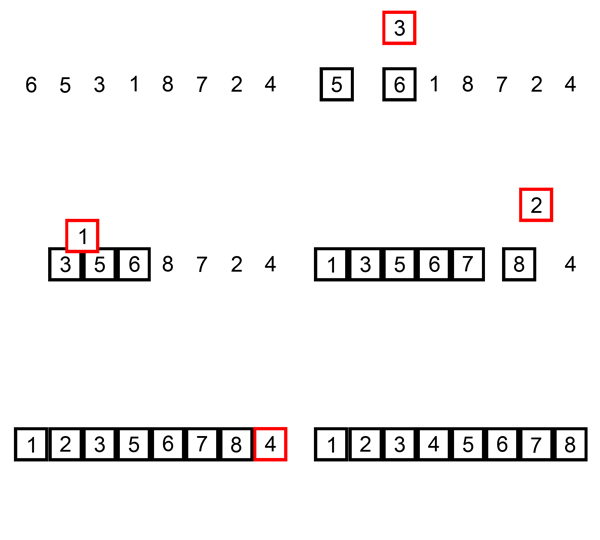
A graphical example of insertion sort. The partial sorted list (black) initially contains only the first element in the list. With each iteration one element (red) is removed from the input data and inserted in-place into the sorted list
Algorithm of Insertion Sort:
Insertion sort iterates, consuming one input element each repetition, and growing a sorted output list. At each iteration, insertion sort removes one element from the input data, finds the location it belongs within the sorted list, and inserts it there. It repeats until no input elements remain.
Example 1:
Input: 4->2->1->3 Output: 1->2->3->4 Example 2:
Input: -1->5->3->4->0 Output: -1->0->3->4->5
def insertionSortList(self, head):
    dummy = ListNode(0)
    dummy.next = head
    while head and head.next:
        while head and head.next and head.val <= head.next.val:
            head = head.next
        node = head.next
        if not node:
            break
        head.next = node.next  # delete "node"
        pre = dummy
        while node.val > pre.next.val:
            pre = pre.next
        node.next = pre.next  # insert "node" in the right position
        pre.next = node
    return dummy.next