题目序号 314、311、288、249、244、187、166、138、36、18、3
314. Binary Tree Vertical Order Traversal
Given a binary tree, return the vertical order traversal of its nodes’ values. (ie, from top to bottom, column by column).
If two nodes are in the same row and column, the order should be from left to right.
Examples:
Given binary tree [3,9,20,null,null,15,7],

    3
   / \
  9  20
    /  \
   15   7

return its vertical order traversal as:

[
  [9],
  [3,15],
  [20],
  [7]
]
Given binary tree [3,9,20,4,5,2,7],
    _3_
   /   \
  9    20
 / \   / \
4   5 2   7


return its vertical order traversal as:

[
  [4],
  [9],
  [3,5,2],
  [20],
  [7]
]
311. Sparse Matrix Multiplication
Given two sparse matrices A and B, return the result of AB.
You may assume that A’s column number is equal to B’s row number.
Example:
A = [
  [ 1, 0, 0],
  [-1, 0, 3]
]

B = [
  [ 7, 0, 0 ],
  [ 0, 0, 0 ],
  [ 0, 0, 1 ]
]


     |  1 0 0 |   | 7 0 0 |   |  7 0 0 |
AB = | -1 0 3 | x | 0 0 0 | = | -7 0 3 |
                  | 0 0 1 |
288. Unique Word Abbreviation
An abbreviation of a word follows the form <first letter><number><last letter>. Below are some examples of word abbreviations:
it –> it (no abbreviation)
1
d|o|g –> d1g
1 1 1
1—5—-0—-5–8
i|nternationalizatio|n –> i18n
1
1—5—-0
d) l|ocalizatio|n –> l10n Assume you have a dictionary and given a word, find whether its abbreviation is unique in the dictionary. A word abbreviation is unique if no other word from the dictionary has the same abbreviation.
Example: Given dictionary = [ “deer”, “door”, “cake”, “card” ]
isUnique(“dear”) -> false isUnique(“cart”) -> true isUnique(“cane”) -> false isUnique(“make”) -> true
def isUnique(self, word):
    val = word
    if len(word) > 2:
        word = word[0]+str(len(word)-2)+word[-1]
    # if word abbreviation not in the dictionary, or word itself in the dictionary (word itself may
    # appear multiple times in the dictionary, so it's better using set instead of list)
    return len(self.dic[word]) == 0 or (len(self.dic[word]) == 1 and val == list(self.dic[word])[0])
249. Group Shifted Strings
Given a string, we can “shift” each of its letter to its successive letter, for example:”abc” -> “bcd”. We can keep “shifting” which forms the sequence:
“abc” -> “bcd” -> … -> “xyz”
Given a list of strings which contains only lowercase alphabets, group all strings that belong to the same shifting sequence.
For example, given:[“abc”, “bcd”, “acef”, “xyz”, “az”, “ba”, “a”, “z”],
Return:
[
[“abc”,”bcd”,”xyz”],
[“az”,”ba”],
[“acef”],
[“a”,”z”]
]
244. Shortest Word Distance II
This is a follow up of Shortest Word Distance. The only difference is now you are given the list of words and your method will be called repeatedly many times with different parameters. How would you optimize it?
Design a class which receives a list of words in the constructor, and implements a method that takes two words word1 and word2 and return the shortest distance between these two words in the list.
For example, Assume that words = [“practice”, “makes”, “perfect”, “coding”, “makes”].
Given word1 = “coding”, word2 = “practice”, return 3. Given word1 = “makes”, word2 = “coding”, return 1.
Note: You may assume that word1 does not equal to word2, and word1 and word2 are both in the list.
187. Repeated DNA Sequences
All DNA is composed of a series of nucleotides abbreviated as A, C, G, and T, for example: “ACGAATTCCG”. When studying DNA, it is sometimes useful to identify repeated sequences within the DNA.
Write a function to find all the 10-letter-long sequences (substrings) that occur more than once in a DNA molecule.
For example,
Given s = "AAAAACCCCCAAAAACCCCCCAAAAAGGGTTT",

Return: ["AAAAACCCCC", "CCCCCAAAAA"].
# Time O(n) one pass, Space O(10*n)
def findRepeatedDnaSequences1(self, s):
    res, dic = [], {}
    for i in xrange(len(s)-9):
        if s[i:i+10] not in dic:
            dic[s[i:i+10]] = 1
        elif dic[s[i:i+10]] == 1:
            res.append(s[i:i+10])
            dic[s[i:i+10]] = 2
    return res

# Time O(n) one pass, Space O(4*n)
def findRepeatedDnaSequences(self, s):
    res = []
    dic = {"A":1, "C":2, "G":3, "T":4}
    dicDNA = {}
    num = 1
    for i in xrange(len(s)):
        num = (num*4 + dic[s[i]]) & 0XFFFFF
        if i < 9:
            continue
        if num not in dicDNA:
            dicDNA[num] = 1
        elif dicDNA[num] == 1:
            res.append(s[i-9:i+1])
            dicDNA[num] = 2
    return res

def findRepeatedDnaSequences(self, s):
    dic, res, l = {}, [], 10
    for i in xrange(len(s)-l+1):
        if s[i:i+l] in dic and dic[s[i:i+l]] == 1:
            res.append(s[i:i+l])
        dic[s[i:i+l]] = dic.get(s[i:i+l], 0) + 1
    return res


The first method stores all the 10-letter-long sequences in dic, so the needed space is O(10n), every single letter needs 1 byte if using ASCII code, while the second method translates a 10-letter-long sequence to a 20-bit long integer, if integer is 4 bytes, then the space needed is O(4n). Two methods operate one pass, so time complexity is O(n).

# Time O(n) one pass, Space O(10*n)
def findRepeatedDnaSequences1(self, s):
    res, dic = [], {}
    for i in xrange(len(s)-9):
        if s[i:i+10] not in dic:
            dic[s[i:i+10]] = 1
        elif dic[s[i:i+10]] == 1:
            res.append(s[i:i+10])
            dic[s[i:i+10]] = 2
    return res

# Time O(n) one pass, Space O(4*n)
def findRepeatedDnaSequences(self, s):
    res = []
    dic = {"A":1, "C":2, "G":3, "T":4}
    dicDNA = {}
    num = 1
    for i in xrange(len(s)):
        num = (num*4 + dic[s[i]]) & 0XFFFFF
        if i < 9:
            continue
        if num not in dicDNA:
            dicDNA[num] = 1
        elif dicDNA[num] == 1:
            res.append(s[i-9:i+1])
            dicDNA[num] = 2
    return res
166. Fraction to Recurring Decimal
Given two integers representing the numerator and denominator of a fraction, return the fraction in string format.
If the fractional part is repeating, enclose the repeating part in parentheses.
For example,
Given numerator = 1, denominator = 2, return "0.5".
Given numerator = 2, denominator = 1, return "2".
Given numerator = 2, denominator = 3, return "0.(6)".
def fractionToDecimal(self, numerator, denominator):
    num, den = numerator, denominator
    if not den:  # denominator is 0
        return
    if not num:  # numerator is 0
        return "0"
    res = []
    if (num < 0) ^ (den < 0):
        res.append("-")  # add the sign
    num, den = abs(num), abs(den)
    res.append(str(num//den))
    rmd = num % den
    if not rmd:
        return "".join(res)  # only has integral part
    res.append(".")  # has frational part
    dic = {}
    while rmd:
        if rmd in dic:   # the remainder recurs
            res.insert(dic[rmd], "(")
            res.append(")")
            break
        dic[rmd] = len(res)
        div, rmd = divmod(rmd*10, den)
        res.append(str(div))
    return "".join(res)
思路 1 - 时间复杂度: hard to say - 空间复杂度: O(1)******
先处理正负号 再处理整数部分 最后处理小数部分,利用字典来判断是否循环 note:对于小数处理部分,必须先进行将没有处理过的r加入到m中去
这是因为:
例如输入为4, 333 如果我们将已经处理过的r加入到m中去的话,重复数字当次就被加入m中了,下一次循环判断的时候r肯定已经在里面了
class Solution(object):
    def fractionToDecimal(self, numerator, denominator):
        """
        :type numerator: int
        :type denominator: int
        :rtype: str
        """
        if numerator == 0: # zero numerator
            return '0'
        res = ''
        if numerator * denominator < 0: # determine the sign
            res += '-'
        numerator, denominator = abs(numerator), abs(denominator) # remove sign of operands
        res += str(numerator / denominator) # append integer part
        if numerator % denominator == 0: # in case no fractional part
            return res
        res += '.'
        r = numerator % denominator
        m = {}
        while r: # simulate the division process
            if r in m: # meet a known remainder
                res = res[:m[r]] + '(' + res[m[r]:] + ')' # so we reach the end of the repeating part
                break
            m[r] = len(res) # if the remainder is first seen, remember next r/denominator index in res
            r *= 10
            res += str(r/denominator) # append the quotient digit
            r %= denominator

        return res
138. Copy List with Random Pointer
A linked list is given such that each node contains an additional random pointer which could point to any node in the list or null.
Return a deep copy of the list.
def copyRandomList(self, head):
    if not head:
        return None
    p = head
    while p:
        node = RandomListNode(p.label)
        node.next = p.next
        p.next = node
        p = p.next.next
        # p = node.next
    p = head
    while p:
        if p.random:
            p.next.random = p.random.next
        p = p.next.next
    newhead = head.next
    pold = head
    pnew = newhead
    while pnew.next:
        pold.next = pnew.next
        pold = pold.next
        pnew.next = pold.next
        pnew = pnew.next
    pold.next = None
    pnew.next = None
    return newhead

def copyRandomList1(self, head):
    if not head:
        return
    # copy nodes
    cur = head
    while cur:
        nxt = cur.next
        cur.next = RandomListNode(cur.label)
        cur.next.next = nxt
        cur = nxt
    # copy random pointers
    cur = head
    while cur:
        if cur.random:
            cur.next.random = cur.random.next
        cur = cur.next.next
    # separate two parts
    second = cur = head.next
    while cur.next:
        head.next = cur.next
        head = head.next
        cur.next = head.next
        cur = cur.next
    head.next = None
    return second

# using dictionary
def copyRandomList(self, head):
    if not head:
        return
    cur, dic = head, {}
    # copy nodes
    while cur:
        dic[cur] = RandomListNode(cur.label)
        cur = cur.next
    cur = head
    # copy random pointers
    while cur:
        if cur.random:
            dic[cur].random = dic[cur.random]
        if cur.next:
            dic[cur].next = dic[cur.next]
        cur = cur.next
    return dic[head]
36. Valid Sudoku
Determine if a Sudoku is valid, according to: Sudoku Puzzles - The Rules.
The Sudoku board could be partially filled, where empty cells are filled with the character ‘.’.
http://sudoku.com.au/TheRules.aspx
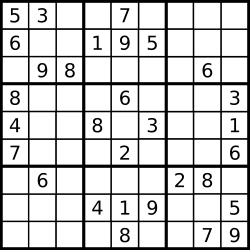
A partially filled sudoku which is valid.
Note: A valid Sudoku board (partially filled) is not necessarily solvable. Only the filled cells need to be validated.
def isValidSudoku(self, board):
    r, c = len(board), len(board[0])
    for i in xrange(r):
        for j in xrange(c):
            if not self.isValid(i, j, board):
                return False
    return True

def isValid(self, x, y, board):
    if board[x][y] == ".":
        return True
    tmp = board[x][y]; board[x][y] = "#"
    r, c = len(board), len(board[0])
    for i in xrange(r):
        if board[i][y] == tmp:
            return False
    for j in xrange(c):
        if board[x][j] == tmp:
            return False
    for i in xrange(x/3*3, x/3*3+3):
        for j in xrange(y/3*3, y/3*3+3):
            if board[i][j] == tmp:
                return False
    board[x][y] = tmp
    return True

def isValidSudoku(self, board):
    return self.checkRows(board) and self.checkColums(board) and self.checkSquares(board)

def checkRows(self, board):
    r, c = len(board), len(board[0])
    for i in xrange(r):
        dic = dict()
        for j in xrange(c):
            if board[i][j] != ".":
                if board[i][j] in dic:
                    return False
                dic[board[i][j]] = 0
    return True

def checkColums(self, board):
    r, c = len(board), len(board[0])
    for j in xrange(c):
        dic = dict()
        for i in xrange(r):
            if board[i][j] != ".":
                if board[i][j] in dic:
                    return False
                dic[board[i][j]] = 0
    return True

def checkSquares(self, board):
    m, n = [0, 3, 6], [0, 3, 6]
    for p in m:
        for q in n:
            dic = dict()
            for i in xrange(p, p+3):
                for j in xrange(q, q+3):
                    if board[i][j] != ".":
                        if board[i][j] in dic:
                            return False
                    dic[board[i][j]] = 0
    return True


def isValidSudoku(self, board):
    return self.checkRowCol(board) and self.checkRowCol(zip(*board)) and self.checkSquare(board)

def checkRowCol(self, board):
    for row in board:
        dic = {}
        for i in row:
            if i != "." and i in dic:
                return False
            dic[i] = 0
    return True

def checkSquare(self, board):
    for i in xrange(3):
        for j in xrange(3):
            dic = {}
            for m in xrange(3):
                for n in xrange(3):
                    val = board[i*3+m][j*3+n]
                    if val != "." and val in dic:
                        return False
                    dic[val] = 0
    return True
18. 4Sum
Given an array S of n integers, are there elements a, b, c, and d in S such that a + b + c + d = target? Find all unique quadruplets in the array which gives the sum of target.
Note: The solution set must not contain duplicate quadruplets.
For example, given array S = [1, 0, -1, 0, -2, 2], and target = 0.
A solution set is: [
[-1, 0, 0, 1], [-2, -1, 1, 2], [-2, 0, 0, 2]
]
3. Longest Substring Without Repeating Characters
Given a string, find the length of the longest substring without repeating characters.
Examples:
Given “abcabcbb”, the answer is “abc”, which the length is 3.
Given “bbbbb”, the answer is “b”, with the length of 1.
Given “pwwkew”, the answer is “wke”, with the length of 3. Note that the answer must be a substring, “pwke” is a subsequence and not a substring.